
How to read an empty house in your Vedic chart
An empty house means that no planets are placed in that house in the chart you are reading. It does not mean that the corresponding part of your life is missing, and a Vedic reading can continue through the house’s sign and ruling planet.
If you have seen an empty seventh house and wondered whether it rules out partnership, pause before accepting that conclusion. A blank-looking area of the drawing is one piece of chart information. It is not an absence of possibility in your life.
Begin with the house, then find its ruler
A house represents an area of life within the chart. Its sign has a traditional ruling planet, sometimes called the house lord. That ruler still exists when the house itself contains no planets.
First establish which chart and house system you are using. In the whole-sign approach used for the example below, the rising sign forms the first house and each following sign forms the next house. This gives us a clear starting point for counting.
Then follow a simple sequence. Identify the empty house. Note its sign. Find the planet that rules that sign. Locate that planet in the same chart.
Those steps describe what is on the page before asking what it means. If you are unsure of the signs or the rising sign, return to the chart’s labels rather than guessing from where a box appears on the screen.
A worked example with an empty seventh house
Imagine a hypothetical birth chart with Sagittarius rising and no planets in Gemini, its seventh whole-sign house. Gemini’s traditional ruler is Mercury. In this example, Mercury is in Virgo, the tenth house.
We can now say something more precise than “the seventh is empty.” The seventh has no planets placed in it, and its ruler is in the tenth. The traditional topics of partnership and public work enter the same interpretive conversation through that connection.
Mercury is in its own sign here, one part of its traditional condition. Its other planetary connections still need examination. A reader can explore how partnership and public responsibilities relate without assuming this person will marry a colleague or put career before love.
For reflection, the person might ask how work commitments affect time with a partner. Do busy weeks need clearer agreements? Is there enough space for both shared plans and individual responsibilities? These questions become useful through lived experience, not because a chart proves their answers.
What comes after locating the ruler?
Traditional interpretation also considers the ruler’s condition and aspects, meaning defined planetary relationships to the house or its ruler. The Brihat Parashara Hora Shastra discusses houses through these factors. It does not make the presence of a planet the only basis for examining a house.
You may hear terms such as strength or dignity at this stage. Ask the reader to explain the specific condition in everyday language and show where it appears. A label such as “weak house” should not become a judgment about your worth or a certainty that something will fail.
Following the ruler gives the reading a connection to examine. Your own circumstances help you decide which questions are worth exploring.
Finish with one clear question
Choose one empty house rather than trying to interpret every blank space at once. Write down its sign, ruler and the ruler’s location. Keep your observation separate from any meaning you are considering.
Then add one question connected to your present circumstances. For partnership, it might concern communication or time together. For work, it might concern a responsibility you want to handle differently. Choose an ordinary action that would help whether or not the symbolism feels accurate.
You do not need to fill the empty house with an imagined planet or a frightening story. Follow the information that is there, then give your own experience room to answer back.
Find it in your own chart
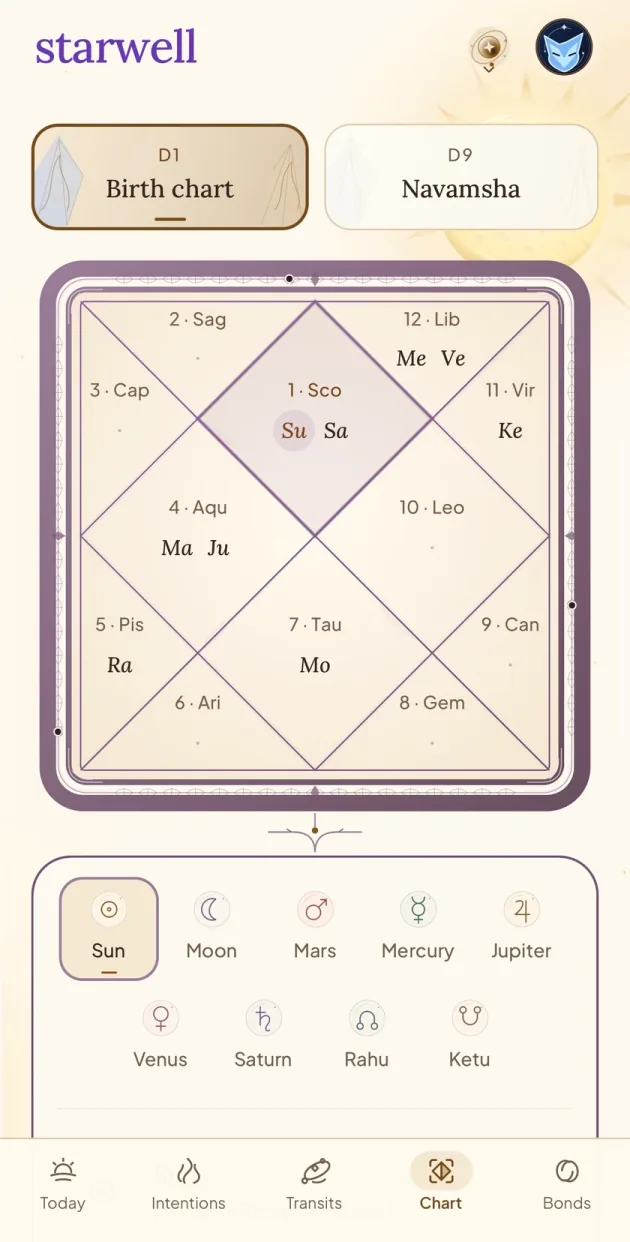
In Starwell, open Chart and choose Birth chart. You can see the house and sign labels, with the planets listed below.
Begin with the house and its sign. Then look for the ruling planet to follow the connection through your chart.
A little more clarity
Does an empty seventh house mean I will not have a relationship?
No. Empty describes the absence of planets placed in that house in the chart being read. Traditional interpretation also examines the house's ruler and planetary aspects. Occupancy alone does not establish a relationship outcome.
What should I look at first in an empty house?
Identify the house and its sign in the chart system you are using, then find that sign's traditional ruling planet. Locate that planet before considering its condition and aspects.
Why do two chart screens show different house placements?
First check that both screens show the same chart and settings. Different house systems or a birth chart versus a divisional chart can change what you are comparing. Establish the shared starting point before interpreting the difference.